
How to Get the Best Cordless Vacuum Under $200 (Without Getting Ripped Off)

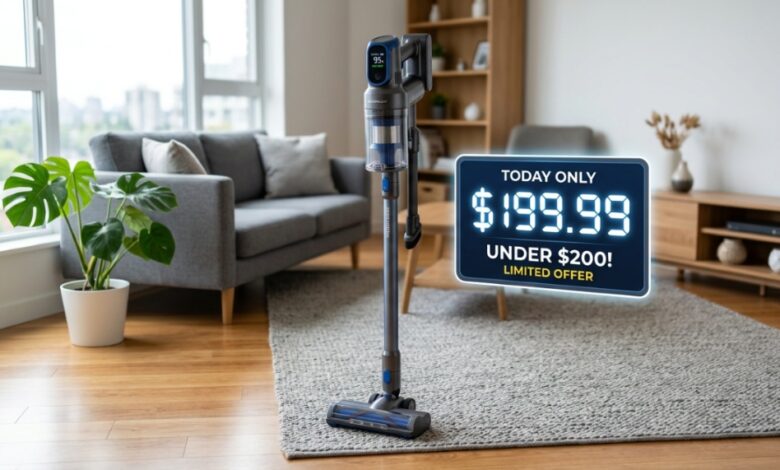
You are standing in the cleaning aisle, staring at a wall of shiny gadgets. One cordless vacuum costs as much as a used car, and another is so cheap you suspect it will just blow dust around. Your back hurts from lugging that clunky corded model, and the tangled cord is literally a tripping hazard. You need freedom from the outlet, but you do not want to break the bank. The good news? You do not have to. Finding a genuinely effective cordless vacuum under 200 is entirely possible if you know which specs actually matter and which marketing buzzwords to ignore. This guide cuts through the noise to help you buy the perfect lightweight, cord-free machine without sacrificing suction power or build quality.
What Features Matter Most in a Budget Cordless Vacuum?
Before you hand over your credit card, you need to understand that a low price tag forces manufacturers to make compromises. The trick is identifying which compromises you can live with and which ones will drive you insane. In the sub-$200 market, the winning formula usually involves prioritizing a high-quality motor over fancy display screens and a lightweight design over massive dustbin capacity.
Suction Power vs. Air Watts
Do not get obsessed with “watts” alone. Look for “Air Watts” (AW) or kilopascals (kPa). A good budget cordless vacuum for hard floors should have at least 15-20 AW. For carpets, you want closer to 25-30 AW. Many budget models claim high wattage but have terrible airflow paths, which means the dirt just sits at the nozzle. Check reviews that mention “pickup on pet hair” or “edge cleaning” to gauge real-world performance.
Battery Life: The Realistic Math
Manufacturers often advertise “up to 40 minutes” of runtime. That is typically on a bare-floor setting with no power brush attached. In reality, if you use the motorized floor head on carpets, you will get about 40-50% of that claimed time. Look for models with a removable battery. This is a non-negotiable feature. With a second spare battery (which costs about $50), you can double your cleaning session instead of waiting 4 hours for a recharge.
Dustbin Capacity and Emptying Mechanism
The biggest annoyance with cheap cordless vacuums is the tiny dustbin. A 0.2L bin is too small. Aim for 0.5L or larger. More critical is the emptying mechanism. A quick-release button that opens the bottom flap is essential. Avoid twist-and-pull systems that require you to stick your hand into a hairy filter chamber. Also, check if the filter is washable. Replacement filters for budget models can be expensive over time.
Why Is Battery Technology the Biggest Cost Driver?
When you pay $400 for a Dyson or a Shark, ~60% of that cost goes into the battery management system and the high-discharge lithium-ion cells. Under $200, you are getting a simpler battery pack. This is fine, but you need to manage your expectations regarding charge cycles and heat degradation.
Which Battery Chemistry Performs Best?
Look for “Samsung” or “LG” branded cells inside the battery pack. These are the gold standard. Some budget vacuums use generic Chinese cells that lose capacity after 12 months. If the product page does not mention cell brand, assume they are generic. You can extend battery life by storing the vacuum off the charger once it’s full. Keeping it plugged in 24/7 will degrade the cells faster.
Can You Replace the Battery Later?
This is the single most important question to ask before buying. If the battery is permanently sealed inside the unit (like some cheap stick vacuums), the vacuum has a lifespan of about 18 months before the battery dies. If the battery is swappable, you can get a new pack for $40-60 and effectively buy yourself a brand-new vacuum. Always filter for “removable battery” in the specs.
When Should You Charge the Vacuum?
Do not wait until the battery hits 0%. Lithium-ion batteries prefer partial cycles. If you vacuum for 10 minutes, put it back on the dock. You also want a model with a “charged indicator light” so you know when it’s ready. The best practice is to charge it immediately after use so it’s always ready for a quick spill cleanup.
Which Type of Vacuum Is Best for Apartments vs. Houses?

Your living situation dictates the ideal form factor. A heavy upright with a long runtime is a waste of space in a 600 sq ft studio. Conversely, a tiny stick vacuum will annoy you if you are dragging it across 2,500 sq ft of carpet. Let’s break down the physical archetypes you will find under $200.
Stick Vacuums: The All-Rounder
These are the most popular. They convert from a floor vacuum to a handheld unit by detaching the wand. Features to look for: a motorized brush roll with LED lights (helps see dust on hard floors) and a wall-mounting dock. In this category, you should specifically look for models that have a “trigger-lock” mechanism, so you do not have to hold the power button down the entire time. That is a finger-killer.
Handheld Vacuums: For Quick Spills and Cars
If you only need to clean crumbs, car interiors, and stairs, a high-end handheld is better. However, “handheld” in the under $200 range often means lower suction. The key here is to look for a model with a motorized brush attachment specifically for pet hair. If you have a long-haired pet, a handheld without a tangle-free brush will be useless.
2-in-1 vs. 3-in-1 Configurations
A 3-in-1 usually includes a mini motorized tool for upholstery in addition to the floor nozzle and crevice tool. This is a great value. But beware of “accessories” that are just plastic tubes with no brush inside. A mini motorized brush doubles the price of the machine, so if it’s included under $200, check the reviews to ensure it actually spins and doesn’t just vibrate weakly.
How to Evaluate Suction Power Like a Pro?
Manufacturers love to print “15,000 Pa” or “High Power” on the box. This number is meaningless without a controlled test. A vacuum’s cleaning ability is determined by the seal between the nozzle and the floor, plus the airflow (CFM). If the vacuum has a leaky seal, high pressure is wasted.
Is High Pa Always Better?
No. Some budget vacuums have high static pressure (Pa) but low airflow. Static pressure is like the strength of a pump, while airflow is how much air you are moving. For sweeping debris, you need airflow. A vacuum with 12,000 Pa but a wide, well-sealed floor head will out-clean a 25,000 Pa vacuum with a narrow, poorly sealed head. Look for the CFM rating (Cubic Feet per Minute). Anything above 15 CFM is acceptable.
How to Test Edge Cleaning on the Spot
If you are shopping in a store, bring a piece of string or a small pile of coffee grounds. Run the vacuum over the edge of the floor head. If the debris gets pushed around instead of sucked up, the edge suction is poor. This is common in budget vacuums because they use a single central suction port. Some models have two ports (one on each side), which is significantly better for corners.
What Is “Digital Motor” Technology?
This simply means the motor runs on DC (battery) and has a controlled speed via a microcontroller. In budget vacuums, this allows for “Eco” and “Turbo” modes. Use Eco for bare floors to extend runtime. Use Turbo only for high-pile carpets or heavy debris. Running in Turbo constantly will overheat the motor and drain the battery in under 10 minutes.
Can a Budget Cordless Vacuum Really Handle Pet Hair?
Yes, but with a caveat. The suction power is usually sufficient to lift pet hair from hard floors and low-pile carpets. The bigger problem is tangling. Pet hair wraps around the brush roll and jams the motor. You need a vacuum with a “tangle-free” brush roll design, often featuring a zigzag pattern or rubber fins instead of bristles. If you live in a smaller apartment or need a secondary tool for quick spot-cleans, you might also want to look into an affordable handheld vacuum that still has strong suction to handle everyday crumbs and tight corners effortlessly.
Why Do Brush Rolls Tangle?
Traditional bristle brushes act like a comb. As the hair wraps around, it gets pulled into the bearing housing. Anti-tangle designs use a curved blade or a comb that sits in the nozzle to strip the hair off before it wraps. Check the product images to see if there is a red or blue fin above the brush roll. That is the anti-tangle comb.
Which Carpet Type Works Best?
Budget cordless vacuums are excellent on hard floors and low-pile (thin) carpets. They struggle with thick, plush, or high-pile carpets. If you have a shag carpet, you need a vacuum with a “carpet height adjustment” slider. If the vacuum doesn’t have this, the brush will either stall on thick carpet or fail to agitate dirt on thin carpet.
Do You Need a Separate “Turbo” Brush for Pet Messes?
If your vacuum includes a mini motorized brush for stairs and upholstery, this is your pet hair weapon. This little tool spins fast and pulls hair out of fabric. It is non-negotiable for pet owners. Many budget vacuums omit this to save money, expecting you to use the main floor head. That is unwieldy for a dog bed.
What Is the Best Way to Use a Cordless Vacuum for Allergies?
If you suffer from allergies, the vacuum itself can be a source of misery if it leaks dust. The filter system is critical. In the under $200 range, you are looking at HEPA or “washable HEPA-like” filters. True HEPA H13 or H14 is rare at this price, but some models do have it.
Is the Filter Sealed?
Check if the vacuum has a sealed system. This means the air passes through the HEPA filter with no gaps that allow bypass. You can test this by running the vacuum and feeling around the seams for air leaks. If you feel air escaping at any joint other than the exhaust vent, it’s leaking allergens.
How Often Should You Clean the Filter?
Washable filters should be cleaned every 4-5 full dustbin empties. But let them dry for 24 hours completely before reinstalling. If you have a metal mesh pre-filter, tap it clean every time you empty the bin. Neglecting the filter will cause suction loss quickly. Buy a model that has a “washable cyclone filter” – this is a cone-shaped piece that you rinse under a tap, not a flat fiber sheet.
Can You Upgrade the Filter Later?
Some budget vacuums take aftermarket HEPA filters made by third-party brands. These are usually cheaper than OEM and sometimes function better. Search for “replacement filter for [Model Name]” on Amazon before you buy. If there are several cheap options, it’s a good sign the machine is popular and has a support ecosystem.
Why Do Most Racers Lose Suction After 6 Months?
This is not a conspiracy; it is physics. The vacuum loses suction because of clogged pre-filters and worn brush rolls. In cheap vacuums, the airway is narrow and has sharp bends. Hair and lint accumulate in these elbows, restricting airflow. The solution is to buy a machine that is easy to disassemble for deep cleaning.
How to Unclog a Narrow Airway?
Look for a vacuum where the wand detaches easily and you can visually inspect the entire path from the nozzle to the dustbin. If the tube is curved (like a hockey stick), it will clog. A straight, wide tube is better. To unclog, you can use a broomstick handle to push the blockage through, but this is only possible if the tube is not permanently sealed.
What Is the Lifespan of a Budget Cordless Vacuum?
With regular maintenance (filter washing, hair cutting, battery care), a good sub-$200 model lasts 2-3 years. If you abuse it (never wash the filter, run it on Turbo all the time), it will die in 6 months. Most budget models have a 1-year warranty. Read the warranty terms carefully. Some brands offer a 2-year warranty if you register the product online.
When Should You Just Throw It Away and Buy New?
If the replacement battery costs more than 60% of the price of a new vacuum, it’s usually not worth it. For instance, if your vacuum was $180 and the battery is $100, you might as well put that money toward a better model. Also, if the plastic of the dustbin is cracked and leaking dust, that is a health hazard. Time to upgrade.
How to Find the Best Cordless Vacuum Under 200 on a Tight Budget?
Sales and deal hunting are part of the game. The sub-$200 market is highly competitive, especially during Black Friday, Cyber Monday, and Amazon Prime Day. New models launch every year, and last year’s flagship drops below $200.
When Is the Best Time to Buy?
Typically, July (Prime Day) and November (Black Friday) see discounts of 30-50% on cordless vacuums. However, if you need one now, check for “renewed” or “certified refurbished” models. These are often returns with minor cosmetic issues, and they come with a warranty. Buying refurbished directly from the manufacturer saves you a lot of money.
Which Brands Offer the Best Value?
In this price range, you are generally looking at brands like Miele (rarely), Bissell, Eufy, GOOVIMO, Hoover, and Tineco. Dyson and Shark rarely go under $200 except for their oldest entry-level models, which are often worse than newer budget brands. The key is to look at the “brushless motor” spec. A brushless motor is more efficient and durable than a brushed motor.
Should You Buy an Older Flasghip or a New Budget Model?
If you can find last year’s premium model (which originally retailed for $300) on sale for $180, buy that. It will have better build quality and suction than a brand new $180 model that was designed to be cheap from the start. However, verify that spare parts are still available for the older model.
What Are the Common Mistakes People Make When Buying a Budget Cordless Vacuum?
There are three traps that consistently catch buyers. First is ignoring the charging time. If a vacuum takes 5 hours to charge and runs for 10 minutes, it’s useless. Look for a model that charges in under 3 hours. Second is buying a model with a fixed power trigger. Third is not checking the included tools.
Is a “Wall Dock” Essential?
A wall dock is not just for storage. It also charges the vacuum and holds your accessories. If a budget vacuum does not have a dock, you have to store it on a shelf, and you will have to plug in a separate charger cable every time. This seems minor, but it’s a huge convenience factor for daily use. Models that cost around $200 usually include the dock; cheaper ones often omit it to save shipping costs.
How to Measure the Noise Level?
Budget vacuums often sound louder because the plastic chassis is thinner and vibrates. If you live in an apartment, check the decibel rating. Most are around 70-75 dB, which is fine. If it’s above 80 dB, it will strain your ears. You can also check for “insulated motor housing” in the description, which might indicate a quieter unit.
If you are looking for specific model recommendations and side-by-side comparisons of the best affordable cordless machines available in New York, check out this detailed list of cordless vacuum under 200. It breaks down the top contenders and their street prices.
Frequently Asked Questions
Why do cordless vacuums lose power when the battery is below 20%?
Most budget vacuums regulate power to protect the battery. When the voltage drops, the motor speed decreases to avoid over-discharging the cells. This is a safety feature, not a defect. You will notice a significant drop in suction speed at low battery, so you should plan your cleaning sessions to finish before the red light comes on.
Can you replace the battery in a cordless vacuum under $200?
Yes, but only if you buy a model with a removable battery pack. Check the product specifications for “Detachable Battery” or “Replaceable Battery. ” If it is not listed, find a teardown video on YouTube to confirm. If the battery is inside the main body and requires screws to remove, it is technically replaceable but not user-friendly.
Is it worth buying a cordless vacuum if you have 100% hard floors?
Absolutely. In fact, hard floors are where budget cordless vacuums excel. Without the need for aggressive carpet brushing, the battery lasts longer and suction is more consistent. You can even use the “Eco” mode for most cleaning, which increases runtime to the maximum. Just ensure you have a soft dusting brush for edges and baseboards.
Which is lighter: a stick vacuum or a handstick?
A “stick vacuum” typically weighs 5.5 to 7.5 lbs. A “handstick” (a term used for smaller stick vacuums) weighs significantly less—usually under 4 lbs. If you have mobility issues or need to clean stairs, the lighter weight is more important than suction. You can always do multiple passes with a lighter vacuum, but you cannot lift a heavy one.
Is the cyclonic separation worth paying extra for?
Yes. Cyclonic vacuums use centrifugal force to keep dirt away from the filter, meaning the filter stays clean longer and suction remains strong. In the sub-$200 range, you should strongly prefer a cyclonic model over a simple bagless one. The difference in performance over a year is night and day. Without cyclonic action, the filter clogs in half the time.
When is the best time to empty the dustbin?
Empty the bin when it is about 70-80% full. Do not wait until it is completely full, as this blocks airflow and strains the motor. Also, never let wet debris sit in the bin overnight; it will cause mold and odor.