


Building a home golf simulator is an exciting investment that transforms your practice routine. However, the hitting surface you choose can make or break your entire setup. A quality mat protects your clubs, provides realistic feedback, and creates an authentic playing experience. Selecting the wrong one, on the other hand, can lead to injuries, damaged equipment, and frustration.
The market offers countless options, each claiming to be the best choice for your needs. Some prioritize durability, while others focus on realism or club protection. Understanding the differences between these products helps you make an informed decision that matches your goals and budget.
This comprehensive guide walks you through everything you need to know about choosing the perfect hitting surface for your simulator. You’ll learn about materials, construction methods, size considerations, and features that truly matter. By the end, you’ll have the knowledge to select a mat that enhances your practice sessions for years to come.
Understanding Different Mat Construction Types
The construction method significantly impacts how a mat performs and feels during use. Different approaches create varying levels of realism, durability, and forgiveness. Therefore, knowing these distinctions helps you prioritize what matters most for your setup.
Traditional rubber-backed mats are the most common and affordable option. They feature synthetic turf on top with a rubber base for stability. These mats work well for casual practice but often feel quite firm. The lack of give can create jarring impacts on your wrists and elbows, especially with irons.
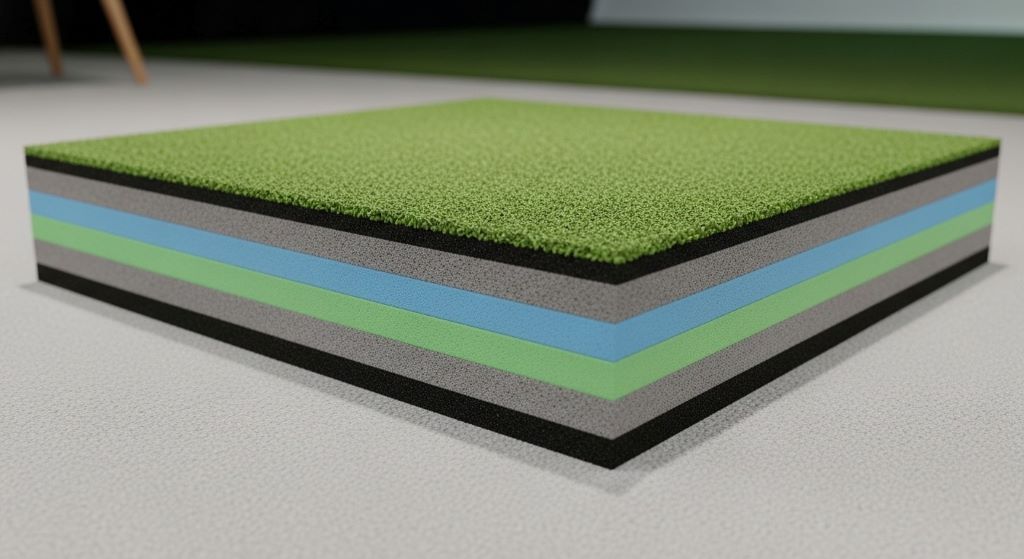
Multi-layer foam systems incorporate several foam densities beneath the hitting surface. These layers compress upon impact, mimicking the feel of hitting off natural turf. Quality foam construction reduces shock transmission while still providing enough resistance for realistic ball flight.
Gel-infused mats represent a newer technology that combines gel layers with foam and turf. The gel absorbs impact energy while maintaining a consistent hitting surface. These mats typically offer the most realistic feel but come at a premium price point.
Modular systems let you customize your hitting experience. They include interchangeable sections with different firmness levels or materials. This flexibility allows you to practice various lies and conditions without owning multiple complete mats.
Evaluating Turf Quality and Realism
The turf surface directly affects how your club interacts with the mat. Poor-quality turf wears quickly, creates unrealistic feedback, and can damage your clubs. Consequently, understanding turf characteristics is essential for making a smart choice.
Fiber length influences how clubs move through the surface. Shorter fibers provide less resistance and work well for fairway shots. Longer fibers better simulate rough conditions but may grab your club more aggressively. Many quality mats use medium-length fibers that balance these factors.
Fiber density determines durability and feel. Dense turf maintains its structure longer and provides more consistent feedback. Sparse turf breaks down quickly and creates bare spots where performance suffers. Look for mats with at least 60 ounces of fiber per square yard.
Blade shape and orientation affect how realistic the surface feels. Some manufacturers use straight fibers, while others incorporate crimped or textured designs. More sophisticated blade patterns create variations in resistance that mimic natural grass more accurately.
Color may seem purely aesthetic, but it affects your practice experience. Dark green surfaces show wear less obviously than light green options. However, lighter colors can make it easier to see your club position and alignment. Consider which aspect matters more for your needs.
Size and Dimension Considerations
Choosing the right size ensures comfortable practice sessions and proper simulator function. Too small, and you risk missing the mat entirely or feeling cramped. Too large, and you waste money and space. Additionally, dimensions affect portability and storage options.
Length matters more than many people realize. A mat should extend far enough forward that you can take a full divot without hitting the floor. Most experts recommend at least five feet of length for full swings. Shorter mats work fine for putting practice or chip shots only.
Width provides lateral space for different stance widths and ball positions. A minimum of four feet gives you room to address the ball comfortably for various clubs. Wider mats offer more flexibility but require more floor space in your simulator room.
Thickness impacts both comfort and performance. Thinner mats under one inch typically feel firm and transmit more shock to your body. Mats between one and two inches provide better cushioning. Anything thicker may create unrealistic feedback or cause the ball to sit too high.
Consider your ceiling height when thinking about mat thickness. Adding a two-inch mat raises your swing plane slightly. In rooms with low ceilings, this change can cause you to hit the ceiling during your backswing, especially with drivers.
Stance mats extend your hitting area and provide consistent footing. Many setups include a main hitting section plus adjacent stance areas. This configuration gives you a larger practice surface without the full cost of a massive single-piece mat.
Durability and Longevity Factors
A simulator golf practice mat represents a significant investment, so durability should rank high on your priority list. Different materials and construction methods offer varying lifespans. Understanding these differences helps you calculate true long-term value.
Backing material affects how well the mat holds up to repeated use. Heavy rubber backing resists curling and stays flat on the floor. Cheaper vinyl backing may crack or separate from the turf over time. Some premium mats use multi-layer backing systems for maximum stability.
Seam construction determines whether multi-piece mats stay together. Heat-sealed seams generally outlast sewn seams. Look for reinforced edges that won’t fray or separate even after thousands of swings. Quality manufacturers often warranty their seams separately from the turf itself.
UV resistance matters even for indoor golf mats if your simulator room has windows. Sunlight degrades synthetic turf fibers over time, causing them to become brittle and break. UV-stabilized materials maintain their properties much longer in spaces with natural light.
Expected lifespan varies dramatically based on quality and usage. Budget mats might last 500 to 1,000 rounds of practice. Mid-range options typically survive 2,000 to 5,000 rounds. Premium mats can withstand 10,000 or more rounds before requiring replacement.
Replaceable hitting areas extend the useful life of some mat systems. Instead of replacing the entire mat when the sweet spot wears out, you simply swap in a new hitting section. This feature significantly reduces long-term costs for frequent users.
Impact on Club Performance and Longevity
Your mat choice directly affects how long your clubs last and how well they perform. Hard surfaces accelerate wear on club faces and can damage shafts. Moreover, unrealistic feedback leads to swing compensations that hurt your on-course game.
Club protection should be a primary concern for anyone with expensive equipment. Mats that are too firm create excessive vibration during impact. This shock travels up the shaft and into your hands, potentially causing injury over time. It also loosens clubhead connections and can crack graphite shafts.
Forgiveness varies between mat types. Some surfaces grab your club face aggressively if you hit behind the ball. Others let the club slide through more naturally, similar to real turf. More forgiving mats help you develop better technique without punishing minor mistakes excessively.
Spin generation changes based on surface texture and firmness. Extremely firm mats may produce more backspin than you’d get on a course. Very soft mats might reduce spin. This inconsistency makes it harder to judge your actual ball flight and distance gaps.
Tee compatibility affects driver and fairway wood practice. Some mats include built-in tee holes or receptacles. Others require you to use rubber tees that sit on the surface. Consider which clubs you’ll practice most when evaluating tee options.
Portability and Storage Options
Not everyone has a dedicated simulator room where a mat can stay permanently. Portability matters if you need to move or store your mat regularly. However, ease of movement often conflicts with stability and quality.
Weight influences both stability and portability. Heavier mats stay in place better during aggressive swings but become difficult to move. A 50-pound mat offers good stability while remaining manageable for one person to relocate. Anything over 100 pounds really needs two people or a dolly.
Rollability determines storage convenience. Some mats roll up tightly for compact storage. Others are too thick or rigid to roll effectively. If space is limited, verify that your chosen mat can roll and store easily before purchasing.
Folding mats offer another storage solution. They fold into sections, often with carrying handles. While convenient, fold lines sometimes create inconsistencies in the hitting surface. Check reviews to see if folding affects performance.
Modular designs break down into smaller pieces that are easier to store and transport. You can often arrange the pieces in different configurations based on your available space. This flexibility comes at a higher price but may be worth it for versatile setups.
Price Ranges and Value Analysis
Understanding the relationship between price and performance helps you maximize your investment. The cheapest option rarely provides the best value, but the most expensive mat may exceed your actual needs.
Budget mats under 200 dollars work for occasional practice or beginners still developing their simulator setup. They provide basic function but often sacrifice durability and realism. These products make sense for testing whether you’ll actually use a simulator before committing more money.
Mid-range options between 200 and 600 dollars offer significantly better quality and longevity. This price bracket includes most products serious golfers should consider. You get improved materials, better construction, and more realistic feedback without entering premium territory.
Premium mats above 600 dollars deliver the most authentic experience and longest lifespan. They use advanced materials, sophisticated construction methods, and often include warranties of several years. Professional instructors and dedicated golfers benefit most from these high-end options.
Consider cost per year of use rather than just initial price. A 400-dollar mat lasting five years costs 80 dollars annually. A 150-dollar mat replaced every year costs more long-term while providing inferior performance. Calculate your expected usage to determine true value.
Package deals sometimes bundle mats with other simulator components. These combinations can save money compared to buying items separately. However, ensure the included mat meets your standards rather than accepting a mediocre product just to get a discount.
Installation and Setup Requirements
Proper installation maximizes mat performance and safety. Some products simply lay on the floor, while others require more involved setup. Additionally, your floor type influences which mats work best.
Floor preparation ensures a stable hitting surface. Concrete floors provide the firmest foundation and work well with most mats. Carpet reduces noise but may compress unevenly under heavy mats. Hardwood floors can work but might suffer damage from mat weight and movement.
Anchoring systems prevent mat migration during use. Heavy mats may not need additional securing. Lighter products might require corner weights, adhesive strips, or Velcro attachments. Consider how permanent you want your installation to be.
Leveling becomes crucial in spaces with uneven floors. Small height variations create awkward stances and affect ball flight. Use shims or leveling compounds to create a perfectly flat surface before placing your mat.
Clearance around the mat affects safety and comfort. Leave at least three feet of space behind you for backswings. Side clearance prevents you from hitting walls during practice. Verify your room dimensions accommodate both the mat and necessary buffer zones.
Integration with launch monitors requires proper positioning. Your mat must align correctly with the monitor’s sensors. Some mats include alignment marks or positioning guides. Measure carefully to ensure accurate ball tracking and club data.
Maintenance and Care Requirements
Proper maintenance extends mat life and maintains performance. Different materials require varying levels of care. Therefore, understanding these needs helps you budget time and money for upkeep.
Regular brushing prevents fiber matting and maintains consistent texture. Use a stiff brush to restore the turf’s natural pile direction. Brushing after every few practice sessions takes just minutes but significantly extends mat life.
Cleaning removes dirt, grass stains, and debris that accumulate over time. Most mats tolerate mild soap and water. Avoid harsh chemicals that might damage synthetic fibers or backing materials. Let the mat dry completely before use to prevent mold growth.
Rotation distributes wear across the entire surface. If your mat allows, periodically rotate it 180 degrees. This practice prevents one area from wearing out prematurely, especially where you hit most frequently.
Indoor golf mat storage between sessions protects against unnecessary wear. Keep the mat away from direct sunlight when not in use. Store in a climate-controlled environment to prevent material degradation from temperature extremes or humidity.
Inspect regularly for damage or wear patterns. Early detection of problems lets you address issues before they worsen. Small repairs like re-gluing seams or replacing worn sections cost much less than buying a new mat.
Special Features Worth Considering
Modern mats offer various features beyond basic hitting surfaces. Some additions genuinely enhance your practice, while others provide minimal benefit. Evaluating these features helps you decide which extras justify additional cost.
Built-in alignment aids help you practice proper setup. Lines, markings, or different colored areas guide your stance and ball position. These visual references improve consistency and help you develop good habits.
Interchangeable inserts let you practice from different lies. Swap between fairway, rough, and tight lie conditions using the same mat. This versatility better prepares you for on-course situations without requiring multiple mats.
Shock absorption technology reduces stress on your joints. Advanced cushioning systems protect your wrists, elbows, and shoulders during extended practice sessions. This feature becomes increasingly important as you age or if you have existing joint issues.
Noise reduction matters in shared living spaces. Some mats dampen the sound of club impact, making practice less disruptive to family members or neighbors. Foam backing generally reduces noise better than solid rubber.
Warranty coverage provides peace of mind with your investment. Quality manufacturers stand behind their products with multi-year warranties. Compare warranty terms, especially regarding wear and tear versus manufacturing defects.
Testing Before You Buy
Whenever possible, try before buying to ensure the mat meets your expectations. Several strategies help you evaluate products without committing to a full purchase.
Visit golf shops or simulator facilities that let you test different mats. Many retailers maintain demo areas where you can take actual swings. This hands-on experience reveals aspects you can’t assess from online descriptions or reviews.
Borrow from friends who already own simulators. Spending time on different mat types clarifies your preferences. You might discover that features you thought essential don’t matter much, or vice versa.
Read detailed reviews from verified purchasers. Look for feedback from golfers with similar handicaps and practice goals. Pay attention to long-term reviews mentioning durability and how well mats maintain their properties over time.
Watch comparison videos created by golf equipment reviewers. These resources often show side-by-side testing that highlights performance differences. Video clearly demonstrates aspects like turf interaction and mat feedback that are hard to convey in writing.
Start with a less expensive option if you’re uncertain. Gain experience with simulator practice before upgrading to a premium mat. Your preferences will become clearer after several months of regular use.
Matching Your Mat to Your Goals
Different practice objectives require different mat characteristics. Aligning your purchase with your specific goals ensures maximum satisfaction and improvement.
Casual players who practice occasionally can succeed with simpler mats. Basic models provide adequate performance for maintaining your game without serious skill development pressure. Prioritize durability and comfort over advanced features.
Competitive golfers need mats that closely simulate on-course conditions. Invest in higher-quality products that provide accurate feedback and don’t encourage swing compensations. Realistic turf interaction becomes crucial for translating simulator practice to course performance.
Players recovering from injuries should prioritize joint protection. Cushioning and shock absorption matter more than absolute realism. A slightly softer mat that lets you practice without pain beats a perfectly realistic surface that aggravates your condition.
Instructors teaching on simulators require durable mats that withstand constant use. Commercial-grade products justify their higher cost through extended lifespan. Features like replaceable hitting areas become essential for maintaining consistent teaching conditions.
Conclusion
Choosing the right golf hitting mat for your simulator setup requires balancing multiple factors. Construction quality, turf characteristics, size, durability, and price all play important roles in your decision. A simulator golf practice mat should protect your clubs, provide realistic feedback, and enhance your improvement trajectory.
Consider how you’ll actually use the mat before prioritizing specific features. Casual players have different needs than competitive golfers or teaching professionals. Your budget, available space, and practice frequency all influence which product offers the best value.
Remember that the mat is just one component of your overall simulator experience. However, it’s the component you physically interact with on every swing. Investing in quality pays dividends through better practice sessions, reduced injury risk, and longer equipment life.
Take time to research options, read reviews, and test products when possible. The perfect indoor golf mat enhances your enjoyment while helping you develop skills that translate to the course. Make an informed choice, and you’ll have a practice surface that serves you well for many years of improvement and enjoyment.
Frequently Asked Questions
What thickness should I look for in a quality golf hitting mat?
Most quality golf mats range from one to two inches thick. This thickness provides adequate cushioning to protect your joints while maintaining realistic feedback. Mats under one inch typically feel too firm and can cause wrist or elbow discomfort. Mats over two inches may create unrealistic ball positioning and take up excessive vertical space in rooms with low ceilings.
How long does a typical golf hitting mat last with regular use?
Lifespan varies significantly based on quality and usage frequency. Budget mats might last 500 to 1,000 practice rounds before showing significant wear. Mid-range products typically survive 2,000 to 5,000 rounds. Premium mats can withstand 10,000 or more rounds when properly maintained. Regular brushing and rotation extend any mat’s useful life considerably.
Can I use the same mat for both irons and woods?
Yes, most quality golf mats work well for all club types. However, some mats optimize for specific clubs. Firmer surfaces generally work better for woods and hybrids, while slightly softer mats feel better for iron shots. Multi-layer foam construction typically provides the best balance for practicing with your entire bag.
Do I need a different mat for left-handed golfers?
Most mats work equally well for both right and left-handed golfers, especially larger models with generous dimensions. However, if you’re purchasing a mat with built-in alignment aids or asymmetric features, verify it accommodates your swing direction. Some manufacturers offer reversible designs or left-handed specific models for mats with directional features.
What’s the difference between commercial and residential golf mats?
Commercial mats use more durable materials and construction methods to withstand constant use in high-traffic facilities. They typically feature replaceable hitting zones and reinforced backing. Residential mats balance durability with cost, as they face much lighter usage. Unless you’re operating a teaching facility or practice regularly with multiple people, residential-grade mats provide adequate performance at lower cost.
Related Topics:
How to Hit a Golf Ball: Beginner-Friendly Tips for Better Swings
Garmin Optical Sensor Causing Zone 3 False Readings